
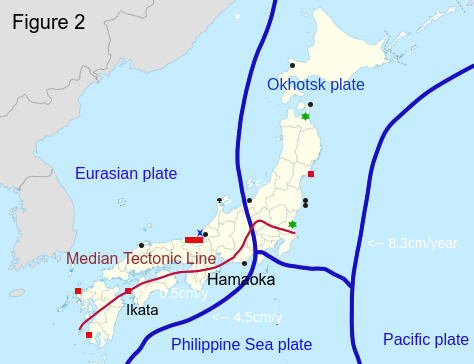
 1. Ikata nuclear power plant:
We are facing big earthquakes of M8.4 called the Nankai Trough Earthquake. The Ikata nuclear power plant is built on the top of the Median Tectonic Line (one of the biggest fault lines in the world) and located in the strong earthquake fault zone of the Nankai Trough Earthquake. In Ikata the No 3 reactor is still running and 770 tons of the spent fuel is stored in the cooling pool.
Definition: When an earthquake occurs, the area where the fault plane breaks and shifts is called the seismic source zone. Especially, near the plate boundaries the area which moves at high speed during an earthquake, generating seismic waves, is called the strong earthquake fault zone. Most of the seismic energy of earthquakes is released in this zone. In the Nankai Trough Earthquake the strong earthquake fault zone includes a large area of the south side of the Median Tectonic Line. It is shown by the circle of grey bold line in Figure 1 (Cabinet office [1]).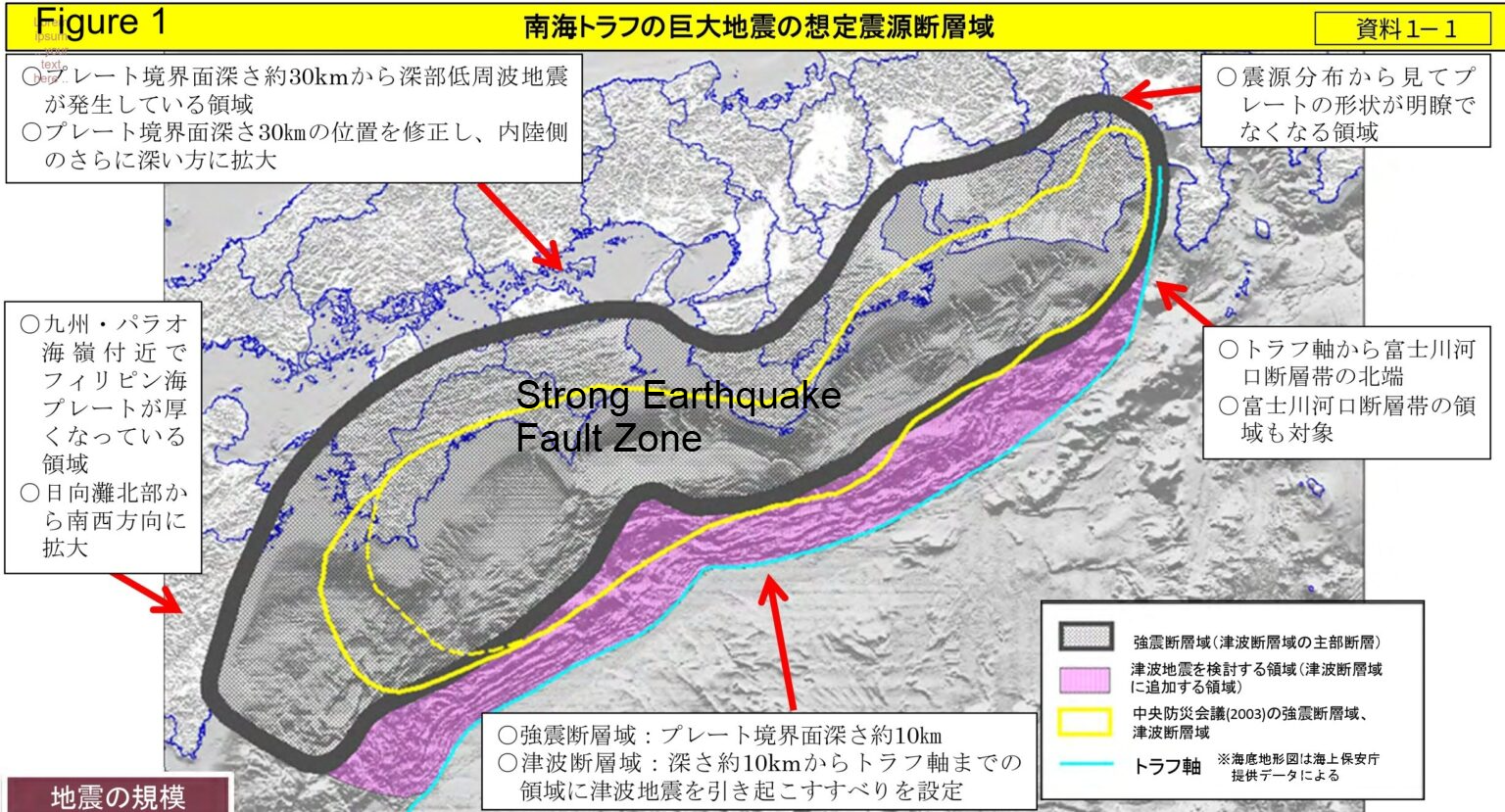
The strong earthquake fault zone was not examined in the safety review of the Ikata nuclear power plant (2013 – 2015).
2. Maximum possible earthquakes:
The earthquake resistant limit of the nuclear power plants is at most 1000 gal. In the safety review of the Ikata nuclear power plant, the maximum size of the possible earthquakes was evaluated as 650 – 1000 gal. This number was derived based on some models but it is completely contrary to our common sense. The following is the list of major earthquakes which occurred in Japan since 2000: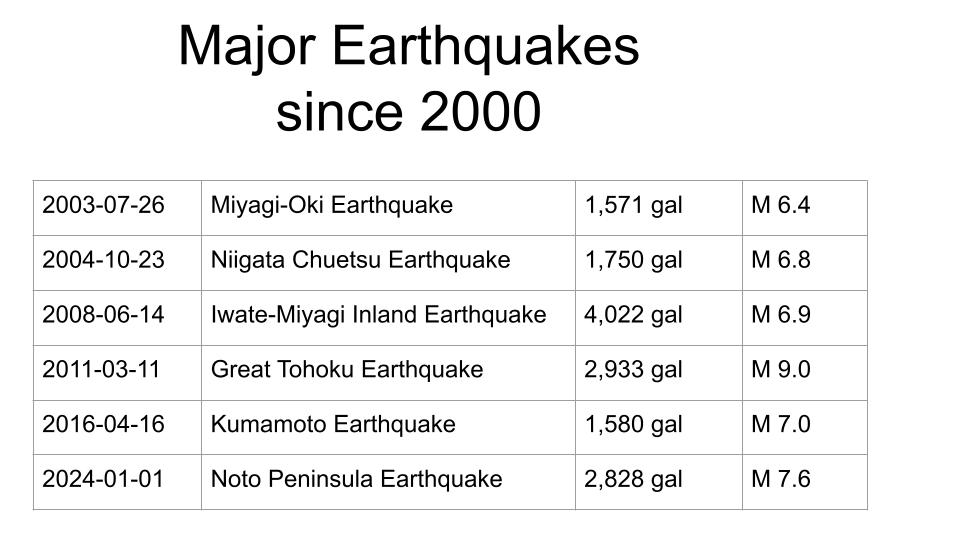
The inland earthquakes such as Iwate-Miyagi Inland Earthquake and Noto Peninsula Earthquake can cause strong quakes even if they are of small size. The Ikata nuclear power plant is located in one of the most dangerous places in Japan (on the top of the Median Tectonic Line and in the strong earthquake fault zone of the Nankai Trough Earthquake). The M8.4 earthquake has 180 times more energy than the M6.9 earthquake. According to the damage estimation by the Cabinet office (NHK [2]), 215,000 people are going to be killed by the tsunami and 73,000 people are going to be killed by the collapse of the buildings. In the inside of the strong earthquake fault zone, many buildings are going to be destroyed by the fierce quake. The maximum possible earthquakes in Ikata must be evaluated at least as large as those earthquakes which actually occurred.
3. Synaliio most likely to occur:
The active reactor in Ikata is PWR (Pressurised Water Reactor) which uses pressurised water for the coolant of the reactor. When the reactor is hit by the extremely fierce quake far beyond the 1000 gal, the pipe rupture will release the coolant rapidly. At about 2,800 °C, fuel rods begin to melt. Molten fuel would breach the bottom of the RPV (Reactor Pressure Vessel) and drop onto the containment floor. The containment would also fail due to the hydrogen explosion or overpressure rupture. The large-scale radioactive release forces the plant workers to evacuate from the site and within a couple of days 770 tons of the spent fuel in the cooling pool will begin to melt. Now no water is remaining in the cooling pool and the massive amount of radioactive substances are going to be released into the environment. The radioactive contamination cannot be undone. All people in Japan will lose safe food and safe water forever. What would happen in the rest of the world? It is very difficult (if not impossible) to cope with the collapsed reactor and 770 tons of the melted spent nuclear fuel. If we cannot solve the problems quickly, clouds containing large amounts of radiation will form one after another and cover the Earth.